
Options trading has become increasingly popular among investors looking to participate in the stock market with comparatively lower capital. If you’re new to derivatives, one of the first questions you’ll likely ask is: what are call options?
Understanding what are call options is essential before you start trading in the derivatives market. In this guide, we’ll explain the concept in simple language, discuss how call options work, highlight their benefits and risks, and walk through a practical example.
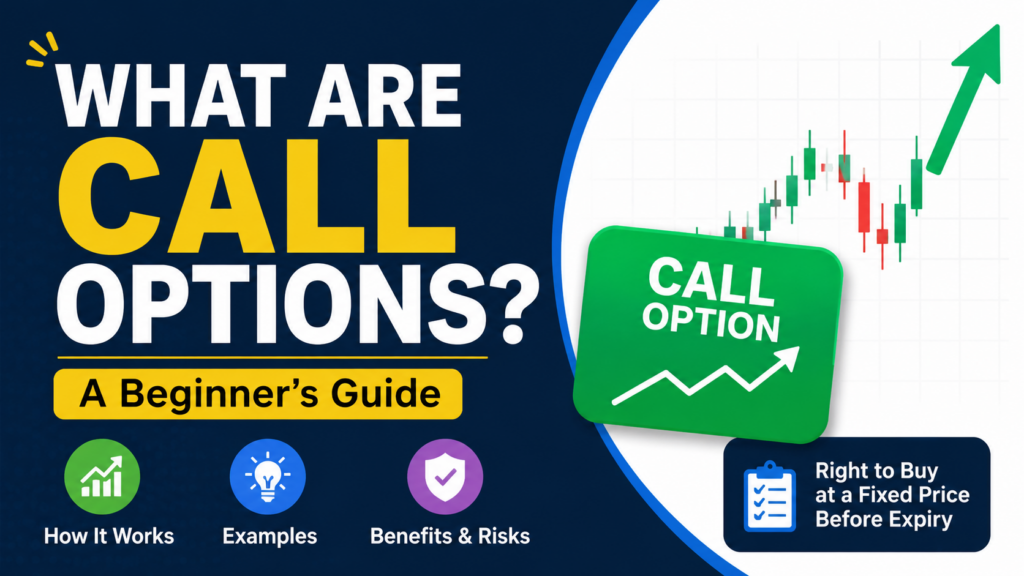
What Are Call Options?
What are call options? A call option is a financial contract that gives the buyer the right, but not the obligation, to purchase an underlying asset—such as a stock or an index—at a predetermined price, known as the strike price, on or before a specified expiry date.
To obtain this right, the buyer pays a fee called the premium. If the market price rises above the strike price by enough to cover the premium paid, the buyer may earn a profit. If the market does not move as expected, the buyer can choose not to exercise the option, limiting the maximum loss to the premium paid.
This limited-risk feature is one reason many traders choose to learn what are call options before entering the derivatives market.
How Do Call Options Work?
The easiest way to understand what are call options is through an example.
Suppose ABC Ltd. is trading at ₹1,000 per share. You believe the stock price may increase over the next month.
You purchase a call option with the following details:
- Current Stock Price: ₹1,000
- Strike Price: ₹1,020
- Premium: ₹20 per share
- Expiry: One month
Scenario 1: Stock Price Rises
If the stock price increases to ₹1,080, the option allows you to buy the shares at ₹1,020.
Example calculation:
- Market Price: ₹1,080
- Strike Price: ₹1,020
- Gain: ₹60
- Premium Paid: ₹20
- Illustrative Net Gain: ₹40 per share
This example is simplified and does not include taxes, brokerage charges, or other transaction costs.
Scenario 2: Stock Price Falls
If the stock price stays below ₹1,020 until expiry, you may choose not to exercise the option.
In this case, your maximum loss is limited to the premium paid (₹20 per share).
This example clearly explains what are call options and how they can be used when an investor expects a bullish market movement.
Key Features of Call Options
Some important features include:
- Right to buy, not an obligation.
- Limited maximum loss for the buyer.
- Lower capital requirement than buying shares directly.
- Fixed strike price.
- Fixed expiry date.
- Premium must be paid upfront.
Understanding these features helps investors better understand what are call options and how they fit into an investment strategy.
Advantages of Call Options
1. Limited Risk
The buyer’s maximum loss is generally limited to the premium paid.
2. Leverage
Call options provide exposure to a larger value of shares with a relatively smaller investment.
3. Potential Opportunity in Rising Markets
If the market moves favourably, call options may offer attractive returns. However, profits are not guaranteed.
4. Portfolio Strategy
Experienced investors sometimes use call options as part of broader portfolio or hedging strategies.
Risks of Call Options
While understanding what are call options, it’s equally important to understand the associated risks.
Time Decay
Options lose value as they approach expiry, even if the stock price remains unchanged.
Premium Loss
If the option expires out of the money, the premium paid may be lost.
Market Volatility
Changes in volatility can significantly impact option prices.
Complexity
Options trading requires knowledge of pricing, market trends, and risk management. It may not be suitable for every investor.
Who Should Consider Call Options?
Call options may be suitable for:
- Investors with a bullish market outlook.
- Traders seeking leveraged exposure.
- Experienced market participants using derivatives strategically.
- Beginners who have first learned the basics and practised through paper trading.
Before trading, always ensure you understand the risks involved.
Buying Stocks vs Buying Call Options
| Feature | Buying Stocks | Buying Call Options |
| Ownership | Yes | No |
| Capital Required | Higher | Lower |
| Maximum Loss | Depends on stock movement | Premium Paid |
| Expiry | No | Yes |
| Leverage | No | Yes |
Tips Before Trading Call Options
Before entering the options market:
- Learn the fundamentals of options trading.
- Understand strike prices and expiry dates.
- Never trade without a clear strategy.
- Use proper risk management techniques.
- Start with smaller positions while learning.
- Stay informed about market news and volatility.
Conclusion
Now that you know what are call options, you have a strong foundation for understanding one of the most widely traded derivative instruments in the stock market. A call option gives the buyer the right—but not the obligation—to purchase an asset at a fixed price before expiry. While call options offer leverage and limited downside risk for buyers, they also involve significant risks and require a sound understanding of market behaviour.
Always invest according to your financial goals, risk tolerance, and level of knowledge. Learning before trading can help you make more informed investment decisions.
Frequently Asked Questions (FAQs)
1. What are call options in simple terms?
A call option is a contract that gives the buyer the right, but not the obligation, to buy a stock or other asset at a predetermined price before the expiry date.
2. What is the maximum loss in a call option?
For a buyer, the maximum loss is generally limited to the premium paid for the option.
3. Are call options suitable for beginners?
Beginners should first understand how options work and practise before trading with real money, as options involve significant risk.
4. What happens if a call option expires worthless?
If the market price does not exceed the strike price sufficiently before expiry, the option may expire worthless, and the buyer loses the premium paid.
Disclaimer: This article is intended for educational purposes only and should not be considered financial or investment advice. Investments in the stock market and derivatives are subject to market risks. Options trading involves significant risk and may not be suitable for all investors. Please consult a qualified financial advisor before making any investment decisions.
About 4R Investments
Looking to begin your investment journey with confidence? 4R Investments Pvt. Ltd. offers guidance on stock market investing, mutual funds, IPOs, and Demat account services to help investors make informed financial decisions.
Visit 4R Investments to explore educational resources and investment solutions designed for both beginners and experienced investors.
For investment guidance and Demat account assistance, contact:
4R Investments
📞 6300169336
📧 contact@4rinvestments.in
🌐 https://4rinvestments.in/
Office Address:
3-1-309/310, Tara Kaushalya Nivas, Nimboliadda, Kachiguda, Hyderabad – 500027
Disclaimer
Mutual Fund investments are subject to market risks, read all scheme-related documents carefully.
Past performance is no guarantee of future results. Mutual Funds do not have a fixed rate of return, and it is not possible to predict the rate of return.
Mutual Funds are not Exchange traded products, and the AOL is just acting as distributor. Please note that all disputes with respect to the distribution activity would not have access to Exchange investor redressal forum or Arbitration mechanism.
Angel One Limited (formerly known as Angel Broking Limited), Registered Office: 601, 6th Floor, Ackruti Star, Central Road, MIDC, Andheri East, Mumbai – 400093. Tel: 080-47480048, CIN: L67120MH1996PLC101709, SEBI Regn. No.: INZ000161534-BSE Cash/F&O/CD (Member ID: 612), NSE Cash/F&O/CD (Member ID: 12798), MSEI Cash/F&O/CD (Member ID: 10500), MCX Commodity Derivatives (Member ID: 12685) and NCDEX Commodity Derivatives (Member ID: 220), CDSL Regn. No.: IN-DP-384-2018, PMS Regn. No.: INP000001546, Research Analyst SEBI Regn. No.: INH000000164, Investment Adviser SEBI Regn. No.: INA000008172, AMFI Regn. No.: ARN–77404, PFRDA Registration No.19092018. Compliance officer: Mr. Bineet Jha, Tel: (022) 39413940 Email: compliance@angelbroking.com